

































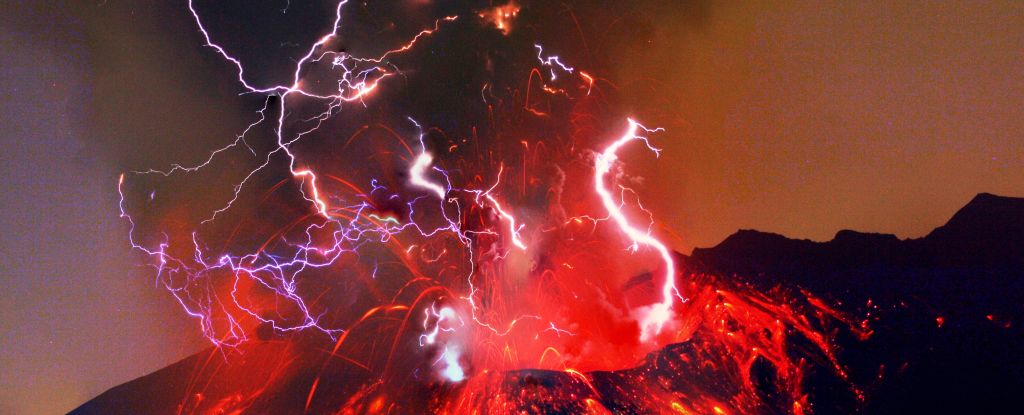
Scientists have hypothesized that the violent tumult of volcanic lightning may have been a catalyst for creating accessible phosphorus and fixing nitrogen, both essential elements for the advent of life on early Earth.
Recent findings provide geological proof that lightning associated with volcanic eruptions could have contributed to nitrogen fixation, thereby making nitrogen available for early biological processes.
The prevalence of intense volcanic activity during Earth’s formative years might have been a fundamental factor in the development of life. Extensive volcanic eruptions could have supplied the necessary building blocks for the rise of living organisms.
“For the first time, significant amounts of nitrate have been discovered in volcanic deposits from very large explosive eruptions,” a team of researchers led by Sorbonne University geoscientist Adeline Aroskay reveals.
“These discoveries lend geological support to the distinctive role that subaerial explosive eruptions may have played in facilitating energy-intensive processes, supplying vital components for life during its origins on Earth.”
Life’s emergence on young and tempestuous Earth involved transforming a concoction of elements into life’s building blocks. Nitrogen, an indispensable nutrient for constructing proteins, amino acids, and nucleic acids, is plentiful on Earth, composing around 78 percent of our atmosphere. However, living organisms cannot utilize atmospheric nitrogen in its N2 form; it needs to be separated and affixed to other atoms.
While current biological processes, such as microbial activity in plant roots, can facilitate nitrogen fixation, and human methods can generate compounds like ammonia, pre-life Earth required non-biological means to initiate nitrogen fixation. This is where the role of electrical discharges, or lightning, is theorized to be essential, a process proven feasible since 1784.
Volcanic eruptions commonly produce lightning, which sparked the idea that volcanic lightning could have been influential in initiating the nitrogen cycle before the dawn of living organisms. Experiments have shown potential, but there was a dearth of geological evidence for fixed nitrogen from such events—until now.
Aroskay’s team has unearthed that evidence in nitrates embedded within ancient volcanic deposits. By examining volcanic eruptions in Turkey and Peru dating between 1.6 and 20 million years ago, they found substantial nitrate levels, likely formed during the eruptions.
The nitrates appeared in all sampled deposits, with features suggesting a volcanic origin. This phenomenon was not limited to the past; younger volcanic deposits also exhibited nitrates, irrespective of the eruption’s explosivity or the deposit’s age, indicating a sudden, rather than gradual, accumulation.
Additional evidence for a volcanic source comes from the consistent presence of sulfur and chlorine, supporting the possibility that volcanic lightning is a significant agent in nitrogen fixation, influencing life’s formation.
This discovery may also help interpret nitrate deposits globally. For instance, nitrates in the Atacama desert previously thought to result from atmospheric deposition may need reevaluation in light of these findings.
Researchers estimate that a single large-scale explosive volcanic event could fix approximately 60 teragrams of nitrogen, signifying the potential role volcanic eruptions might have played in delivering key nutrients for life on early Earth.
This research is detailed in the Proceedings of the National Academy of Sciences.
FAQs:
- 1. Why is nitrogen important for life?
- Nitrogen is essential for the formation of proteins, amino acids, and nucleic acids, which are crucial for all living organisms.
- 2. Can living organisms use atmospheric nitrogen directly?
- No, atmospheric nitrogen (N2) must be fixed into more reactive compounds like nitrates or ammonia before it can be utilized by living organisms.
- 3. How did early Earth facilitate nitrogen fixation without biological processes?
- Before biological processes evolved, non-biological methods such as lightning (electrical discharges) are thought to have played a role in nitrogen fixation.
- 4. What new evidence have scientists discovered regarding nitrogen fixation?
- Scientists have found geological evidence of nitrates in ancient volcanic deposits, suggesting that volcanic lightning could fix nitrogen in significant amounts.
- 5. What can the discovery of nitrates in volcanic deposits imply about other nitrate deposits around the world?
- This finding may lead to a reevaluation of the origins of nitrate deposits in areas like the Atacama desert, where volcanic activity rather than atmospheric deposition may be responsible for their presence.
Conclusion:
The investigation into early Earth’s conditions continues to yield fascinating insights into the possible mechanisms that may have facilitated the emergence of life. The discovery of geological evidence indicating that volcanic lightning could fix substantial amounts of nitrogen opens up new avenues for understanding how life’s essential ingredients were supplied. By extending our knowledge of Earth’s past, this research also informs the search for life elsewhere in the universe, highlighting the profound impact that planetary phenomena like volcanic activity can have on the potential for life to arise.