

































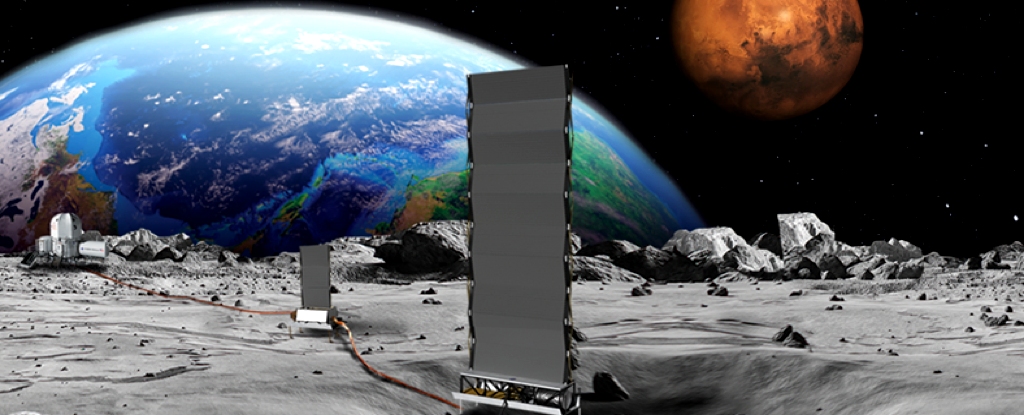
Securing a reliable source of energy is crucial for sustained human presence on the Moon, which is why NASA has focused on powering the Artemis lunar bases through nuclear energy.
The Fission Surface Power Project, aimed at devising a small nuclear fission reactor to supply electricity on the Moon, has recently completed its first phase – marking a significant step for the project initiated in 2022.
Under phase one, companies Lockheed Martin, Westinghouse, and IX were each granted three $5 million contracts for 12 months to refine their fission reactor concepts. These contracts were awarded to further the preliminary designs tailored to NASA’s specifications for lunar application.
The contractors’ design responsibilities encompassed the reactor core itself, as well as associated power conversion, heat rejection, and power management and distribution systems, in addition to projecting costs and development timelines. NASA’s endgame is a decade-lasting system that could also pave the way for Martian power systems.
With the ultimate objective being survival in the harsh environments of the Moon and Mars, NASA sees nuclear power as a key to fulfilling long-duration mission power requirements.
According to Trudy Kortes from NASA’s Space Technology Mission Directorate, a Moon-based nuclear power demonstration is crucial for establishing its safety, cleanliness, and reliability as a power source, especially through the technically challenging lunar nights.
The Case for Fission Reactors
Given the numerous challenges of lunar habitation, having a reliable and safe power source is indispensable. Solar power is reliable when available, but it’s limited during the lunar night which lasts approximately two Earth weeks.
NASA acknowledges the likelihood of combining solar and nuclear power for sustaining its lunar encampments, with nuclear reactors offering constant power regardless of light conditions, complementing the intermittency of solar energy.
Specifications of Moon-Bound Nuclear Reactors
NASA has requested reactor designs capable of a 10-year lifespan without human upkeep to mitigate radiation hazards and free astronauts to focus on their missions. The specifications call for less than six metric tons in weight and an output of 40 kilowatts of power, sufficient for the demands of lunar outposts and science activities.
The project encourages innovative approaches by setting broad requirements, leading to a diversity of submitted designs, as observed by project manager Lindsay Kaldon at NASA’s Glenn Research Center.
Following the conclusion of Phase 1 and the integration of industry feedback, NASA plans to launch Phase 2 in 2025, with an aim to deploy a nuclear reactor on the Moon in the 2030s and an eye on future adaptations for Mars.
This article was originally published by Universe Today. Read the original article.
FAQs about NASA’s Moon Nuclear Reactor Initiative
- Why does NASA want to put a nuclear reactor on the Moon?
- NASA aims to establish a reliable, continuous power supply for lunar bases that will support human and robotic presence on the Moon.
- What is the Fission Surface Power Project?
- The Fission Surface Power Project is NASA’s initiative to develop small-scale nuclear fission reactors to provide continuous power on the Moon and potentially Mars.
- What was achieved in the initial phase of the project?
- In the initial phase, three companies were contracted to develop fission reactor designs with the goal of supporting lunar bases for at least ten years without human intervention.
- When might a nuclear reactor be operating on the Moon?
- NASA expects to deliver a functional nuclear reactor system on the Moon in the early 2030s.
- Will nuclear power be the sole source of energy on lunar bases?
- Not necessarily. NASA anticipates using a combination of solar power and nuclear power to meet the electricity needs of lunar bases.
Conclusion
NASA’s foray into nuclear fission technology for lunar exploration marks an exciting chapter in space exploration. The completion of the first phase of the Fission Surface Power Project catapults us closer to establishing a sustainable human presence beyond Earth. Not only does this endeavor show promise for lunar colonies, but it also sets the groundwork for future ventures on Mars, enhancing our capability for interplanetary exploration and settlement.