





























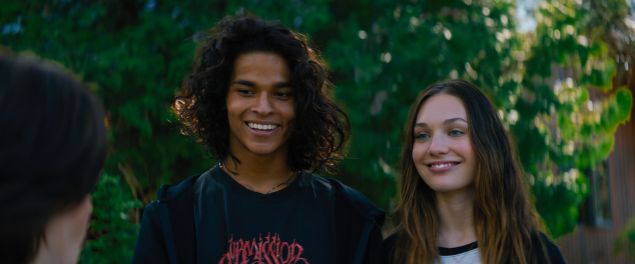

The complexities of teenage life get a unique exploration in Fitting In, a film that navigates the turbulent waters of adolescence with sensitivity and relevance. Maddie Ziegler stars as Lindy, a sixteen-year-old dealing with the ordinary trials of growing up. Yet, Lindy’s reality is complicated by a diagnosis of MRKH syndrome—a reproductive disorder entailing a missing or underdeveloped uterus and a shortened vagina. Her desires are typical for her age: romance, acceptance, and a meaningful connection with her crush Adam, portrayed by D’Pharaoh Woon-A-Tai of Reservation Dogs fame. Lindy’s condition comes with stigmatizing baggage, leading her to conceal it and ultimately end things with Adam.
|
FITTING IN ★★★ (3/4 stars) |
Fitting In draws from director Molly McGlynn’s own experiences with MRKH. It’s a poignant narrative that delivers an unfiltered look at Lindy’s circumstances. Maddie Ziegler delivers a nuanced and bravely transparent performance, echoed by Djouliet Amara playing Vivian, Lindy’s best friend. Vivian’s outward boldness mirrors the insecurities many teens face, adding depth and relatability to the film.
The movie also features Emily Hampshire, recognized for her role as Stevie in Schitt’s Creek. Hampshire depicts Lindy’s mother, a single parent managing her own emotional trauma. The portrayal may miss the mark for some viewers—the age dynamics and appearances sparking a sense of inauthenticity. Ziegler’s embodiment of Lindy radiates empathy and genuineness, whereas Hampshire seems less fittingly cast, detracting rather enhancing the pivotal mother-daughter dynamic.

At its heart, Fitting In launches a dialogue about authentic self-expression amid the pressures of public scrutiny, a challenge amplified in our digital age. For Lindy, the film’s central conflict illuminates a journey of self-acceptance, transcending the desire for validation from others. Through this tender coming-of-age tale, McGlynn presents an exploration of womanhood and invites audiences to contemplate the impersonal nature of clinical interactions, particularly as they reflect a failure of empathy in dealing with sensitive health issues.
Originally premiering as ‘Bloody Hell’ at SXSW, Fitting In tackles much more than personal adversity; it propels conversation about identity, sexuality, and women’s health. While the film emerges from a seemingly niche context, the narrative captures a broad spectrum of universally recognizable themes, encouraging much-needed conversation on topics that often remain shrouded in silence.
### FAQ Section
- What is the main theme of ‘Fitting In’?
The main theme of ‘Fitting In’ is about finding and embracing one’s identity during the challenges of adolescence. It specifically addresses the importance of self-acceptance and challenges the stigma surrounding reproductive health. - Who stars in the film ‘Fitting In’?
Maddie Ziegler, D’Pharaoh Woon-A-Tai, Djouliet Amara, and Emily Hampshire are among the stars of the film. - What disorder does the protagonist have in the movie?
The protagonist, Lindy, is diagnosed with MRKH syndrome, a disorder that affects her reproductive development. - What has been the reception to ‘Fitting In’?
‘Fitting In’ has received positive reviews, with particular praise for Maddie Ziegler’s performance, the film’s treatment of sensitive topics, and its overarching narrative that resonates with a wide audience.
### Conclusion Section
Fitting In stands as a resonant film, mirroring the personal journeys of many, wrapped in the specific experience of its protagonist. With performances that illuminate the stark realities of adolescent life, the feature film transcends its independent roots. It’s a warm invitation to viewers to empathize with the hidden struggles many face, aiming to destigmatize topics that are often left in the shadows—a testament to the power of cinema in reflecting and propelling crucial societal conversations.