


































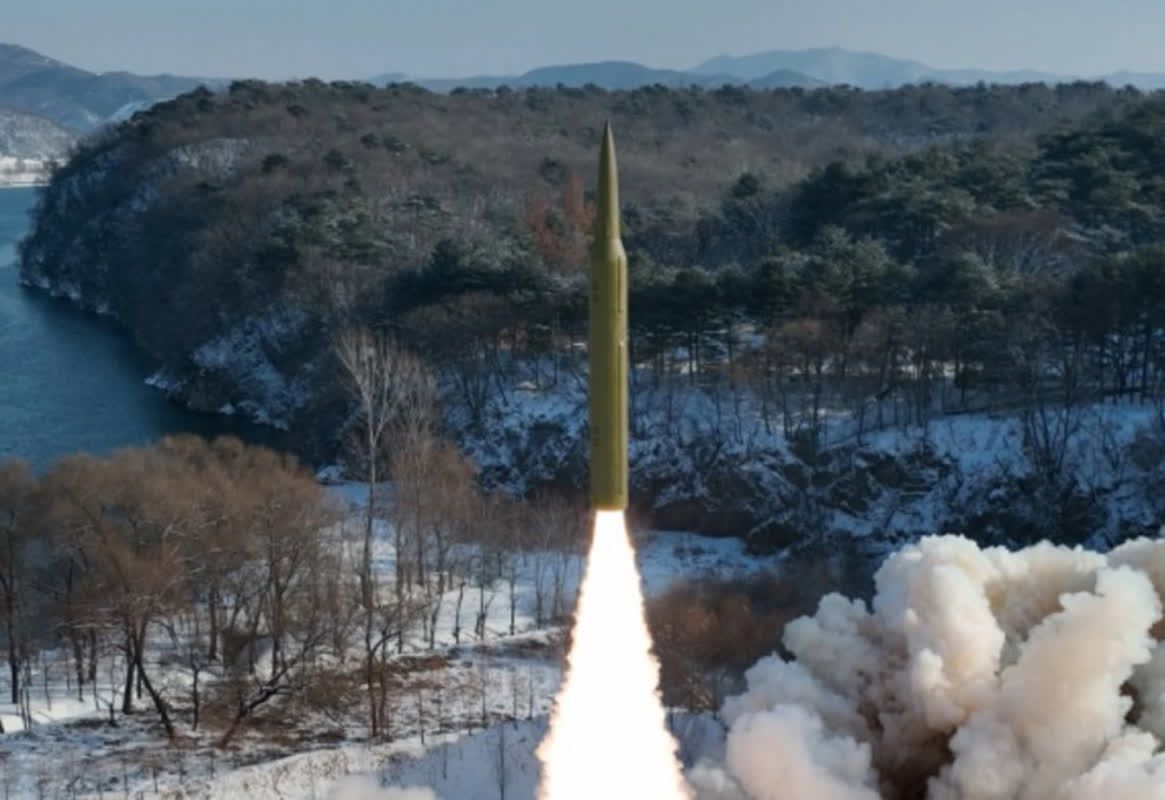

A recent launch of a hypersonic missile by North Korea has been captured and reported by their Central News Agency, raising global interest and concern.
North Korea’s Central News Agency claimed on the 15th that they had successfully tested a medium-range solid-fuel ballistic missile fitted with a hypersonic maneuverable warhead on January 14th. The test’s purpose was to assess the warhead’s flight and maneuverability alongside the reliability of novel solid fuel engines.
Interpreting North Korea’s Test Launch
North Korea asserts to have tested a solid rocket capable of hypersonic, low-altitude flight with a rapid response, departing from traditional liquid rocket designs.
On September 28, 2021, North Korea had utilized a boost-glide method with a liquid rocket for launching a Mars-8 ballistic missile. Despite this, their declared speed and range during that test fell short of the hypersonic benchmark of Mach 5.
The recent test, reportedly an advanced version of Mars-8, was conducted with a solid rocket, showing progress in their missile technology.
Questions Surrounding North Korea’s Achievements
There have been variations in the reported distance covered by the missile between US-Korea alliance’s data and Japan’s observations, with the former implying a range of approximately 621 miles, which would signify a significant improvement in their capabilities.
Notably, the speed of the missile has not been disclosed, leading to speculation about whether North Korea has indeed managed to test a hypersonic weapon.
South Korea is maintaining a cautious stance regarding official announcements due to the potential defense challenges such a weapon could pose to their Korean Air and Missile Defense system.
A Closer Look at Boost-Glide Weapons
Boost-glide weapons differ from conventional ballistic missiles in their descent phase, using the atmosphere to maintain a glide path rather than following a parabolic trajectory. This allows them to extend their range and complicate interception efforts.
The Difficulty in Intercepting Boost-Glide Weapons
Boost-glide weapons complicate defense strategies considerably compared to conventional ballistic missiles due to their unpredictable flight patterns and capability to make subtle turns in flight.
South Korea’s Defensive Strategies
South Korea is actively developing countermeasures with the recent approval of the L-SAM Block II project, aimed at enhancing its capabilities to intercept hypersonic weapons. They plan to integrate interceptors into the KF-21 Boramae fighter jet and deploy a significant number of missiles for an effective response.

An illustration of the Cheongung Block II system’s test launch, designed to intercept advanced missile threats, exemplifies South Korea’s commitment to bolstering its defense capabilities.
To help understand these complex defense issues, a timely e-book, Air-to-air Armament for KF21 and New Technologies for Cheongung and L-SAM, has been released, coinciding with North Korea’s latest missile launch. The e-book serves as a valuable resource for understanding the intricacies of hypersonic weaponry and defense strategies.
FAQ Section
- What speed is considered hypersonic?
- Hypersonic speed is defined as Mach 5 and above.
- What did North Korea claim about its recent missile test?
- North Korea’s Central News Agency reported a successful test of a medium-range ballistic missile with a hypersonic maneuverable warhead.
- Why is there uncertainty regarding North Korea’s hypersonic capabilities?
- There has been a lack of speed disclosure and differing reports on the distance covered by the missile, leaving room for speculation.
- What are some of the challenges in intercepting boost-glide weapons?
- Boost-glide weapons have unpredictable flight paths, can extend their range, and can make subtle directional changes, making interception difficult.
- How is South Korea preparing to defend against hypersonic threats?
- South Korea is developing the L-SAM Block II and plans to deploy a large missile arsenal to effectively counter such threats.
Conclusion
The recent hypersonic missile test by North Korea, although shrouded in some ambiguity, highlights the advancing missile technologies that pose new challenges to national and regional security. While it remains uncertain whether North Korea has fully mastered hypersonic capabilities, the consistent efforts to enhance their missile systems demand vigilant monitoring and robust countermeasures. As a result, South Korea’s proactive development of defense systems, such as the L-SAM Block II, is an essential step toward deterring and defending against this emerging class of weaponry. Continued vigilance, development, and information sharing will be central to maintaining stability and peace in the region and beyond.