






























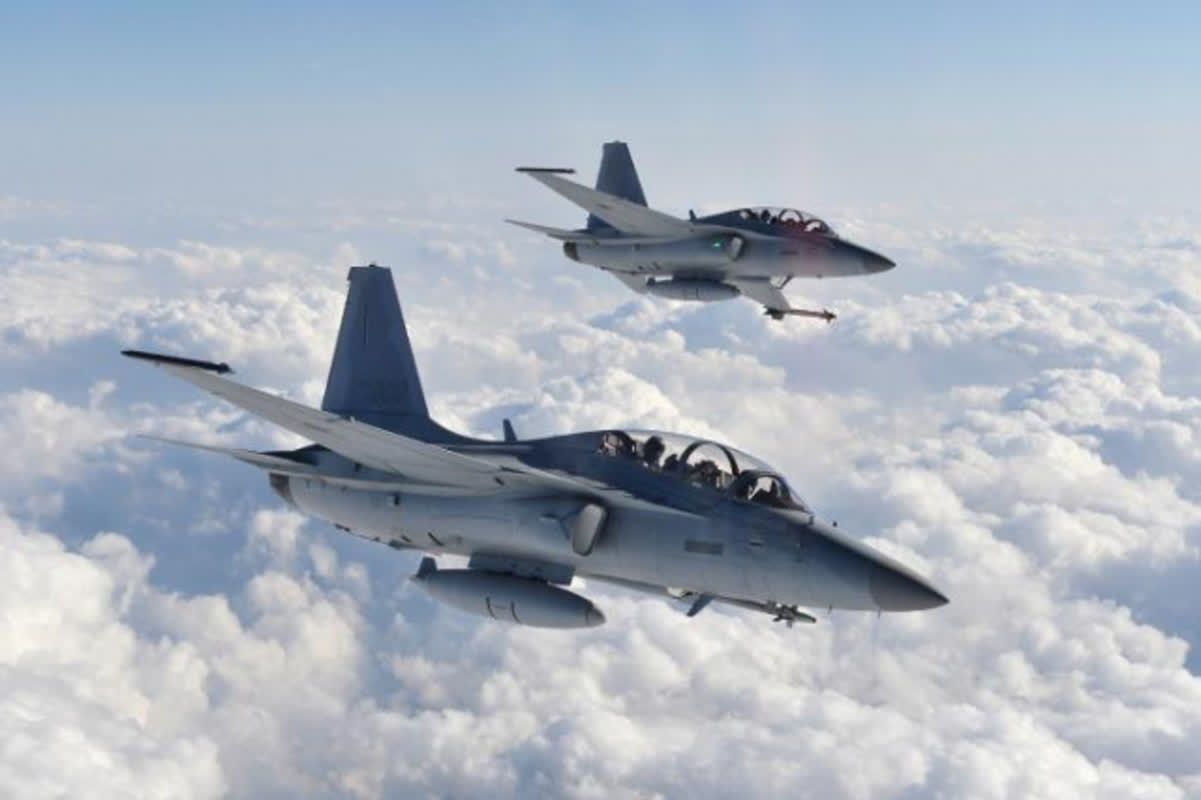
The T-50’s 4.5-ton Arsenal Includes Smart Munitions
The T-50 jet comes equipped with a Radar Warning Receiver (RWR), which is crucial for detecting incoming radar-based threats and a Countermeasures Dispensing System (CMDS) capable of deploying chaff and flares to counteract such threats. These integral survival systems support battlefield situational awareness by promptly identifying and evaluating hostile activities, thereby allowing effective countermeasures and augmenting the survivability of both pilots and aircraft.
In an effort to bolster its nocturnal warfare capabilities, Night Vision Goggles (NVG) have been integrated into the aircraft’s systems, facilitating effective night attack missions. The employment of Night Vision Imaging Systems (NVIS) mitigates pilot disorientation during nighttime operations and enriches the jet’s nocturnal operational proficiency. The FA-50 variant makes use of GPS guidance systems to effectively employ weapons like the Joint Direct Attack Munition (JDAM) and Wind Corrected Munitions Dispenser (WCMD).
A Link-16 tactical data link system is also a feature of the FA-50, allowing real-time sharing of vital battlefield intelligence, aligning with network-centric warfare strategies. The FA-50 is propelled by the F404-GE-102 engine similarly used in the TA-50, which showcases enhanced reliability and performance stability due to its digital control system. Notably, the F404 engine enables the jet to achieve a top speed of Mach 1.5, courtesy of its maximum 8-ton thrust capability.
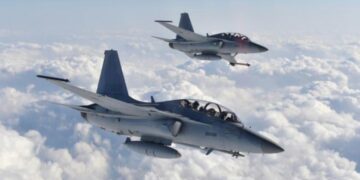
This aircraft is able to bear loads up to 4.5 tons which encapsulate an array of weaponry, ranging from standard missiles for both air-to-air and air-to-ground engagements, conventional bombs, and machine guns, to more sophisticated weapons such as the JDAM and Sensor Fuzed Weapon (SFW). The FA-50’s maximum takeoff weight stands at 27,117 pounds, which is marginally heavier than the F-5E/F’s 24,691 pounds but considerably lighter than the KF-16’s 42,285 pounds.
![The Republic of Korea’s first supersonic fighter ‘TA-50’ series... Capable of Mach 1.5, equipped with radar warning receivers and night attack capabilities [Reporter Lee Hyun-ho's Military! Talk]](https://contents-cdn.viewus.co.kr/image/2024/02/CP-2023-0094/image-bf044f8d-5f29-434c-b7e0-7ce1256ad700.jpeg)
The T-50 model is regarded as the premier instructor aircraft for training in the operation of state-of-the-art jets like the F-16 and F-35. Its creation as a supersonic trainer leveraging a digital flight system and contemporary combat tools justifies this regard.
With aerodynamic designs maximized for performance, the T-50 can reach speeds of up to Mach 1.5, ascend to altitudes as high as 48,000 feet (approximately 14,630 meters), and sustain a practical altitude of 40,000 feet (around 12,192 meters). Equipped with a jet engine capable of delivering 17,700 pounds (roughly 8 tons) of thrust, the aircraft can achieve a maximum takeoff weight of 23,638 pounds (about 10 tons).
Featuring a digital flight control system (FBW·Fly-By-Wire) for elevated maneuverability and an advanced digital engine control system (F-404-GE-102 engine), the aircraft assures improved stability. Moreover, the aircraft framework and landing gear are engineered to withstand structural loads surpassing general fighter jet criteria, culminating in its distinction as a high-performance trainer aircraft.
The T-50 weighs 14,285 pounds (about 6.4 tons), with its size and weight constituting 80% and 70%, respectively, of the F-16 fighter jet. It mirrors the F-16’s agility and has armament capacities comparable to the F-4. The expected lifespan of the T-50’s airframe exceeds 8,000 flight hours. Owing to these specifications, the T-50 is recognized as an advanced trainer and is notably associated with the production of ‘Red Muffler’ pilots from the Air Force 1st Combat Flight Group.
Part. 1
Part. 3
Frequently Asked Questions (FAQs):
- Q: What is the maximum speed of South Korea’s T-50 aircraft?
A: The T-50 can reach a maximum speed of Mach 1.5. - Q: What kind of weapons can the T-50 carry?
A: It can carry up to 4.5 tons of armaments, including air-to-air and air-to-ground missiles, bombs, machine guns, and precision-guided weapons like JDAM and SFW. - Q: Can the T-50 operate at night?
A: Yes, with the integration of Night Vision Goggles (NVG) and Night Vision Imaging Systems (NVIS), the T-50 is capable of performing night attack missions. - Q: What engine does the T-50 use?
A: The T-50 uses the F404-GE-102 turbofan engine, renowned for its digital control system that enhances reliability and stability. - Q: How does the T-50 compare in weight and size to the F-16?
A: The T-50’s weight is about 70% and its size is about 80% of the F-16.
Conclusion:
The Republic of Korea’s T-50 jet represents a significant development in their air force capabilities, combining speed, maneuverability, and a broad range of armaments, including smart weapons. Its ability to conduct night missions, communicate with networked forces in real-time, and withstand rigorous combat conditions makes it a formidable aircraft. The T-50’s design as a high-performance advanced trainer ensures that it prepares pilots for the demands of modern aerial warfare with a focus on the next generation of fighter jets like the F-16 and F-35. With South Korea’s investment in such advanced technology, the T-50 is a testament to their commitment to maintaining a strong and versatile air force.