

































A coordinated effort by the FBI, the National Crime Agency of the U.K., and other global enforcement agencies has been successful in destabilizing the infamous LockBit ransomware syndicate.
The notorious LockBit ransomware group, which would shame its victims on a dark web platform by threatening to disclose their sensitive data unless a ransom was met, has seen its operations interrupted. This intervention includes the seizure of the gang’s dark web page for leaking data.
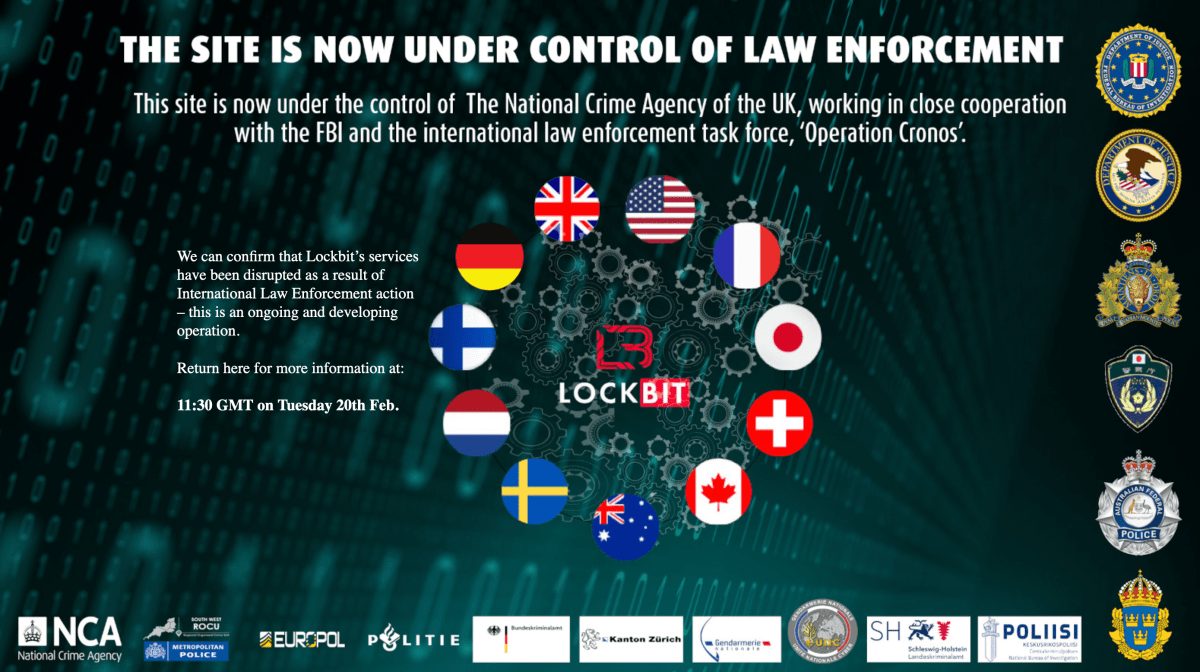
As of Monday, visitors of the LockBit leak site were greeted by a banner stating the site’s seizure by the U.K.’s National Crime Agency, in collaboration with the FBI and ‘Operation Cronos,’ a comprehensive international law enforcement mission. “Lockbit’s services have been disrupted as a result of International Law Enforcement action,” the notice clarified, indicating the case’s active and progressive nature.
The compromised leak site now displays not just the message but also the badges of various international law enforcement bodies, inclusive of Europol, and agencies from France, Japan, Switzerland, Canada, Australia, Sweden, the Netherlands, Finland, and Germany.
National Crime Agency spokesperson Hattie Hafenrichter has acknowledged the interruption of LockBit’s services owing to international law enforcement exertion and iterated the operation’s current and evolving status.
As of now, there are scarce details about any arrests or the complete scope of this operation, with anticipations of further updates to come.
LockBit is believed to conduct its operations from Russia, rendering any arrests improbable. Before the shutdown, LockBit claimed a base in the Netherlands, disavowing any political affiliations and citing financial motives.
Since its conception in 2019, LockBit evolved to become a major player on the ransomware scene, with an estimated 1,800 ransomware offenses across the globe, leading to ransoms totaling around $91 million. LockBit’s rap sheet includes prominent institutions such as Boeing, TSMC, and the Royal Mail in the U.K.
This disruption continues a pattern of law enforcement taking down ransomware groups, similar to the December action that targeted the dark web leakage site belonging to the ALPHV, or BlackCat, ransomware gang.
This article will be updated as more information becomes available.
FAQs about the LockBit Ransomware Group’s Dark Web Leak Site Seizure
- What is the LockBit ransomware group?
LockBit is a cybercrime group that operates a ransomware-as-a-service model and has been responsible for numerous ransomware attacks globally since late 2019. - What was the purpose of LockBit’s dark web leak site?
The site was used to list the gang’s victims and to threaten the release of their stolen data unless a ransom was paid. - Which law enforcement agencies were involved in the seizure?
The seizure was a cooperative effort involving the U.K.’s National Crime Agency, the FBI, Europol, and law enforcement from France, Japan, Switzerland, Canada, Australia, Sweden, the Netherlands, Finland, and Germany, among others. - Have any arrests been made?
At the time of reporting, details about arrests have not been disclosed. The situation is ongoing and further information is expected to be released in due course. - Why is an arrest of LockBit operators believed to be unlikely?
As the operators are thought to be based in Russia, which has historically not cooperated with extraditions for cybercrimes, arrests are considered unlikely. - What is the significance of this takedown for global cybersecurity?
The disruption of LockBit’s operations is part of a larger trend of international collaborative efforts to combat ransomware and is significant in deterring future cybercrimes.
Conclusion
The recent disruption of the LockBit ransomware group’s operations serves as a powerful reminder of the effectiveness of international cooperation in combating cyber threats. While the implications of this enforcement action are still unfolding, the seizure of the LockBit dark web leak site represents a noteworthy victory against ransomware proliferation. The cyber community awaits further details on the operation, and authorities around the world remain vigilant, ready to combat any subsequent threats arising from such malevolent entities.