
































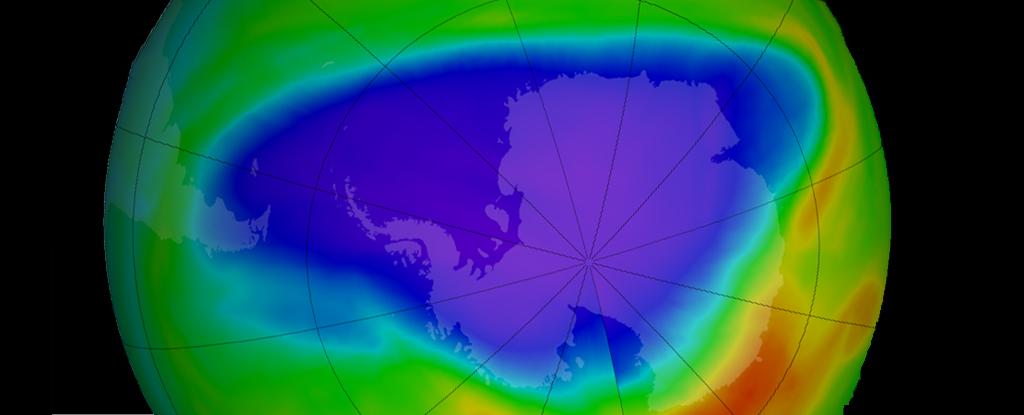
On Tuesday, a consortium of scientists announced a noteworthy environmental achievement, indicating that the decline of ozone-damaging gases surpassed anticipated rates due to international protective measures.
The Montreal Protocol, an accord established in 1987, targets the phase-out of substances that contribute to ozone layer depletion. These substances are commonly used in refrigeration, air conditioning, and aerosols.
According to a recently published study, hydrochlorofluorocarbons (HCFCs), which are prominent culprits in creating ozone layer perforations, reached their atmospheric zenith in 2021. Remarkably, this peak occurred a full five years before predictions suggested.
Luke Western of the University of Bristol in the United Kingdom, who spearheaded the study, told AFP, “This has been a huge global success. We’re seeing that things are going in the right direction.”
By 2010, chlorofluorocarbons (CFCs), which are more detrimental to the ozone layer, had been completely phased out. HCFCs, the replacements for CFCs, are on track to be eradicated by 2040.
The investigative work, featured in the journal Nature Climate Change, analyzed atmospheric pollutant concentrations using data from the Advanced Global Atmospheric Gases Experiment and the US National Atmospheric and Oceanic Administration.
Western credits the marked reduction in HCFCs to the Montreal Protocol’s effectiveness, along with stricter domestic guidelines and proactive industry changes in anticipation of future restrictions.
He expressed a positive outlook on environmental legislation, emphasizing, “In terms of environmental policy, there is some optimism that these environmental treaties can work if properly enacted and properly followed.”
The reduction of both CFCs and HCFCs, which double as potent greenhouse gases, simultaneously supports climate change mitigation efforts.
While CFCs persevere in the atmosphere for many decades, HCFCs have an estimated atmospheric lifespan of roughly twenty years, explained Western.
The lingering presence of these chemicals will continue to impact the ozone layer well after their production ceases.
Projections by the United Nations Environment Programme in 2023 suggest it may take up to forty years before the ozone layer fully revives to pre-1980s levels, when the depletion was first observed.
© Agence France-Presse
FAQs about Ozone Layer Recovery
- What is the Montreal Protocol?
The Montreal Protocol is an international treaty signed in 1987, designed to phase out the production of substances that cause ozone depletion. - What are HCFCs and why are they harmful?
Hydrochlorofluorocarbons (HCFCs) are compounds used in refrigeration, air conditioning, and aerosols that contribute to the depletion of the ozone layer and are also potent greenhouse gases. - When did HCFCs reach their peak levels in the atmosphere?
A study indicated that HCFC levels peaked in 2021, five years earlier than previous projections. - How long do CFCs and HCFCs remain in the atmosphere?
CFCs can linger in the atmosphere for centuries, whereas HCFCs have a shorter lifespan of about two decades. - When is the ozone layer expected to fully recover?
The United Nations Environment Programme estimates that it could take up to forty years for the ozone layer to restore to its state before the 1980s.