

































[ad_1]
When the sky above Berlin lit up during the night of January 21st, 2024, it was due to the explosion of an asteroid – named 2024 BX1 – as it barreled through Earth’s atmosphere. This event, which occurred at 12:33 am UTC, has led to the discovery and identification of unusual meteorite fragments known as “aubrites.”
The original space rock belonged to the Apollo group of Near-Earth Asteroids (NEAs) before its fiery descent.
An expert group comprising members from the Freie Universität Berlin, Museum für Naturkunde (MfN), German Aerospace Center (DLR), Technische Universität Berlin, and SETI Institute worked together to track down the remnants of this unique asteroid.
These fragments share a name with the French village of Aubrés – the location of a similar space rock impact in 1836.
The recovery operation was spearheaded by Dr. Peter Jenniskens of the SETI Institute and Dr. Lutz Hecht from the MfN, supported by students and staff from various Berlin institutions, and located the meteorite pieces near the village of Ribbeck, approximately 50 km west of Berlin.
The search was challenging due to the deceptively normal appearance of aubrites, which often blend into the surrounding environment but reveal their true nature upon closer inspection.
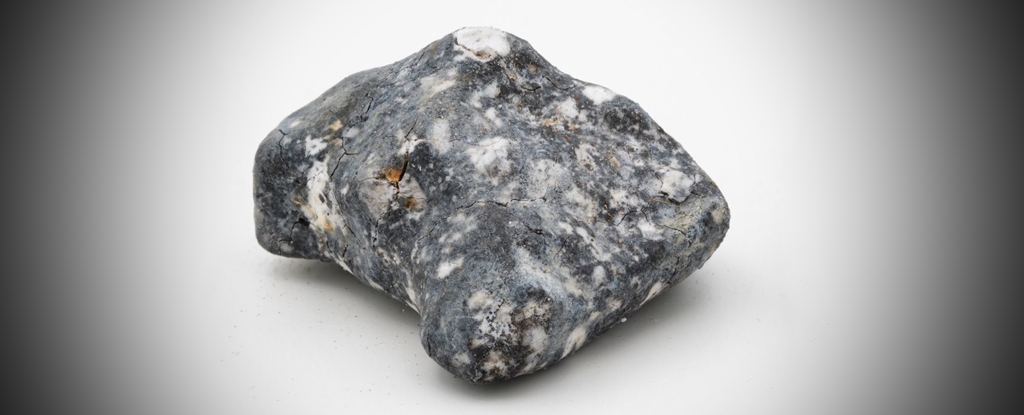
Unlike most meteorites, which display a dark glassy exterior, aubrites are covered by a mostly translucent glass crust and are composed primarily of magnesium silicates enstatite and forsterite, with minimal iron content. Christopher Hamann from the Museum für Naturkunde provided insights on the unusual properties of aubrites and the challenges they present in field identification.
“Aubrites do not look like what people generally imagine meteorites to look like. They resemble gray granite and consist mainly of enstatite and forsterite.
Their minimal iron content and the distinctly different glassy crust compared to other meteorites makes them tricky to spot.”
Dr. Krisztián Sárneczky first detected asteroid 2024 BX1 from the Konkoly Observatory in Budapest. Afterward, both NASA’s Scout mission and the ESA’s Meerkat Asteroid Guard, with trajectory updates from Davide Farnocchia at JPL/Caltech, were vital in tracking and predicting its atmospheric entry point.
This Berlin event, reminiscent of the 2013 Chelyabinsk meteorite, was observed by many, albeit without any accompanying damage.
Dr. Peter Jenniskens has been involved in several such recovery efforts before, but this incident posed new challenges, overcome with the assistance of a Polish team of meteorite hunters and the quick work of Freie Universität students.
“The strong winds and predictions from meteor astronomers like Drs. Pavel Spurný, Jirí Borovicka, and Lukáš Shrbený, coupled with guidance from previous finders, were instrumental in our eventual success.”
Subsequent to the recovery, Dr. Ansgar Greshake led an initial examination of the fragments at the MfN, employing electron beam microprobe techniques to study their mineralogy and chemistry. This study confirmed the aubrite classification, which was submitted to the International Nomenclature Commission of the Meteoritical Society for validation.
Greshake emphasized the rapid categorization and the pivotal role of meteorite collections in scientific inquiry, noting the rarity of this type of space rock.
The discovery and ongoing research surrounding these meteorite fragments were first reported by Universe Today. You can find additional details in their original article.
[ad_2]
FAQ Section
What are aubrite meteorites?
Aubrite meteorites are a rare type characterized by a mostly translucent glass crust and composed mainly of magnesium silicates enstatite and forsterite with minimal iron content.
How was asteroid 2024 BX1 tracked?
It was first detected by Hungarian astronomer Dr. Krisztián Sárneczky, and then NASA’s Scout mission and ESA’s Meerkat Asteroid Guard, along with trajectory updates from JPL/Caltech’s Davide Farnocchia, tracked its path until atmospheric entry.
Where were the aubrite fragments found?
The meteorite fragments were located in fields south of the village of Ribbeck, nearly 50 km west of Berlin.
Has the classification of the aubrite meteorite fragments been verified?
An initial study has confirmed their classification, and the results have been submitted to the International Nomenclature Commission of the Meteoritical Society for verification.
Why are aubrite meteorites difficult to identify in the field?
Aubrites can be tricky to detect due to their atypical appearance resembling common rocks rather than having the distinct black glassy crust seen on most other meteorites. This makes them blend into their environment, making field identification a challenge.
Conclusion
The successful identification and recovery of the aubrite meteorite fragments from the explosion of asteroid 2024 BX1 over Berlin is a significant achievement for the scientific community. The rarity and peculiar characteristics of aubrites provide a unique opportunity to study these enigmatic celestial visitors. This event not only adds to our collections and knowledge of meteorites but also showcases the importance of international collaborations in tracking and recovering these space rocks for further research.