






























[ad_1]
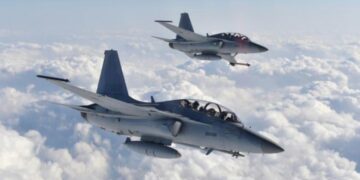
![South Korea's first supersonic fighter, the ‘TA-50’ series... capable of reaching up to Mach 1.5 with enemy threat warning receivers and night attack capabilities [Military Talk by Reporter Lee Hyun-Ho]](https://contents-cdn.viewus.co.kr/image/2024/02/CP-2023-0094/image-6e161533-8057-413a-8e92-e3299be49b39.jpeg)
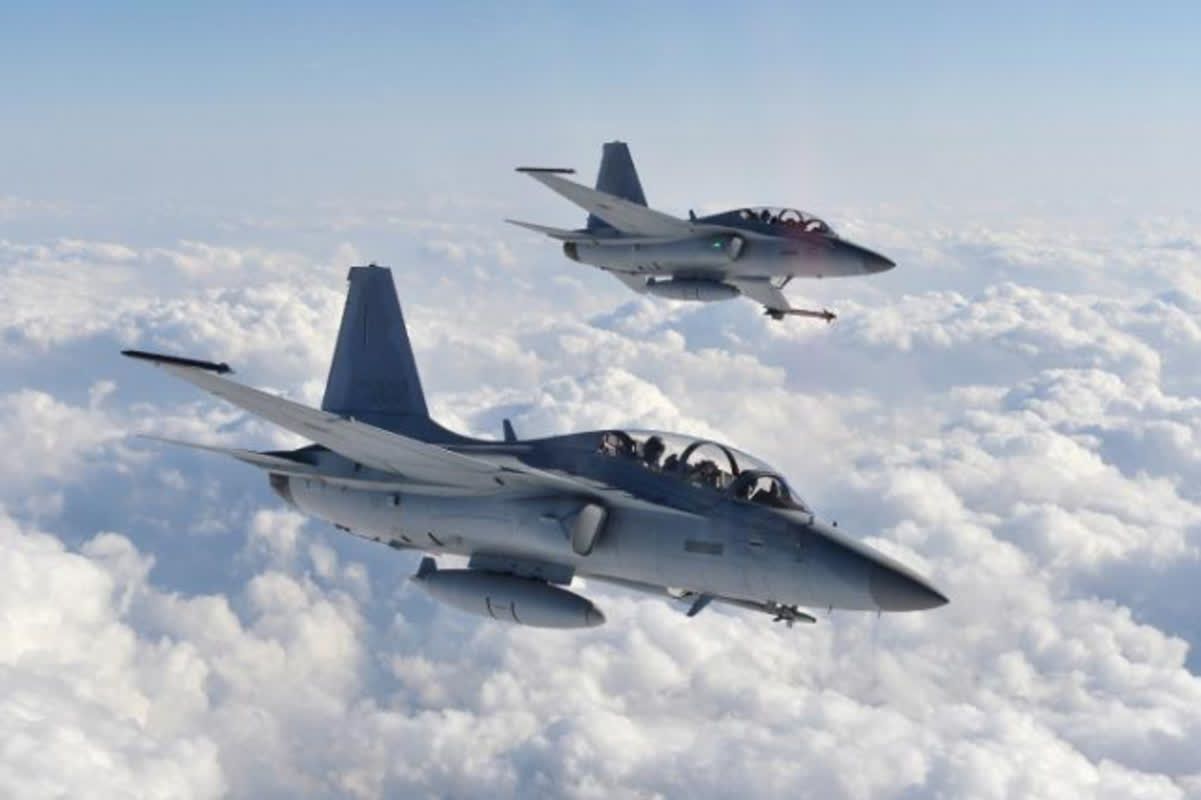
Developed domestically in South Korea, the T-50 series represents the country’s premier supersonic jet trainers and light attack aircraft. This innovation positioned South Korea as the twelfth nation globally to create a supersonic aircraft using indigenous technology. The model, formally known as the T-50 Advanced Trainer, goes by the moniker Golden Eagle. It spans 43.96 feet in length, has a wingspan of 31 feet, and stands 16.1 feet tall. The aircraft boasts a maximum velocity of Mach 1.5, a takeoff mass of 29,660.99 pounds, and is capable of reaching a service ceiling of 48,500.65 feet.
The T-50’s development was spearheaded by Korea Aerospace Industries (KAI), beginning this ambition in 1990 and escalating to comprehensive development with Lockheed Martin from the US in 1997. The aircraft was finalized in October 2001 and took to the skies for its inaugural public flight in August the following year.
On February 19, 2003, the jet shattered the sound barrier, and following endurance tests validating its 25-year operational life, it entered mass production in 2005.
Fleet of over 140: The T-50 Series Comprising T-50, TA-50, T-50B, and FA-50 Models
Noted for its reliable construction and superior capabilities, the T-50 Golden Eagle advanced trainer has led to a lineage of mission-specific jets, including fighter variants. Almost two decades post initial production, the T-50 family has seen successful exports to five countries, totaling 120 units. The South Korean Air Force is reported to possess more than 140 of these aircraft, across the categories of advanced trainers (T-50), aerobatic jets (T-50B), introductory tactical trainers (TA-50), and light attack models (FA-50).
Primarily serving to train aspiring fighter pilots for aircraft such as the F-15A, F-16, and F-22, the TA-50 trainer is lauded for its top-tier performance thanks to an advanced digital flight system, highly agile digital control engines, robust frame, and sturdy landing gear, among others, setting it apart from its contemporaries.
In 2011, South Korea entered the exclusive club of just six supersonic aircraft exporting nations, alongside the US, Russia, UK, France, and Sweden, by signing a deal to supply 16 T-50is to Indonesia. The T-50 series further expanded its international footprint with shipments of 24 T-50IQ jets to the Iraqi Air Force, 12 T-50PH models to the Philippines, and 12 T-50TH to Thailand.
![South Korea's first supersonic fighter, the 'TA-50' series... capable of reaching up to Mach 1.5 with enemy threat warning receivers and night attack capabilities [Military Talk by Reporter Lee Hyun-Ho]](https://contents-cdn.viewus.co.kr/image/2024/02/CP-2023-0094/image-5ff1ef3d-e4dc-4e33-9540-bd897d294239.jpeg)
South Korea’s initial combat jet, the FA-50, is an attacker fostered from the TA-50, through cooperative development between KAI and Lockheed Martin, aimed at replacing older models like the A-37B and F-5E/F in the Air Force. Enhanced with refined flight capabilities from the T-50 trainer, the FA-50 integrates tactical data links, precision-guided munitions, and defense systems. It has been mission-ready since its 2013 deployment.
While based on the TA-50 tactical introductory model, the FA-50 variant ups the ante with auxiliary threat detection, nocturnal operations enhancement, tactical data links, and advanced precision strike capabilities. The radar system of the FA-50 was upgraded from the initial AN/APG-67 to the EL/M-2032, made in Israel. An initial consideration to install the Vixen 500 Active Electronically Scanned Array (AESA) radar was scrapped in favor of mechanical radar, owing to export compliance requirements. The EL/M-2032’s variety of air-to-air and air-to-surface modes mark it ideal for strike missions, with its SAR imaging capacity working in sync with precision weaponry to elevate the FA-50’s mission efficacy significantly.
Part 2
Part 3
[ad_2]
FAQ Section
- What is the T-50 series of aircraft?
- The T-50 series includes South Korea’s first domestically developed supersonic jet trainers and attack aircraft, such as the advanced trainer T-50, the aerobatic T-50B, the tactical introductory TA-50, and the light attack FA-50.
- What is the maximum speed of the FA-50 Golden Eagle?
- The FA-50 Golden Eagle can reach a maximum speed of Mach 1.5.
- Who was involved in the development of the T-50 series?
- Korea Aerospace Industries led the development of the T-50 series with collaboration from Lockheed Martin of the United States.
- When did the FA-50 enter service?
- The FA-50 light attack aircraft became operational in 2013.
- Which countries have imported the T-50 series aircraft?
- The T-50 series has been exported to Indonesia, Iraq, the Philippines, and Thailand.
Conclusion
The ingenuity and strategic partnerships behind South Korea’s T-50 series aircraft have not only enabled the nation to enter the exclusive circle of supersonic jet developers and exporters but have also contributed significantly to global defense capabilities. With its advanced technological features and multi-role functions, the FA-50 Golden Eagle stands out for its efficiency and operational effectiveness, making it a noteworthy addition to air forces around the world. The journey of the Golden Eagle from conception to global presence is a testament to South Korea’s growing prominence in the aerospace industry.