

































In a landmark achievement for space exploration, China’s Chang’e-6 spacecraft has successfully collected samples from the far side of the moon and is now en route to Earth.
Launched from Chinese soil, the mission began after the spacecraft lifted off shortly after 12.30am UK time on a Tuesday, as reported by the China National Space Administration.
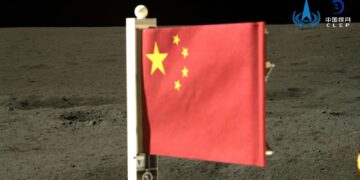
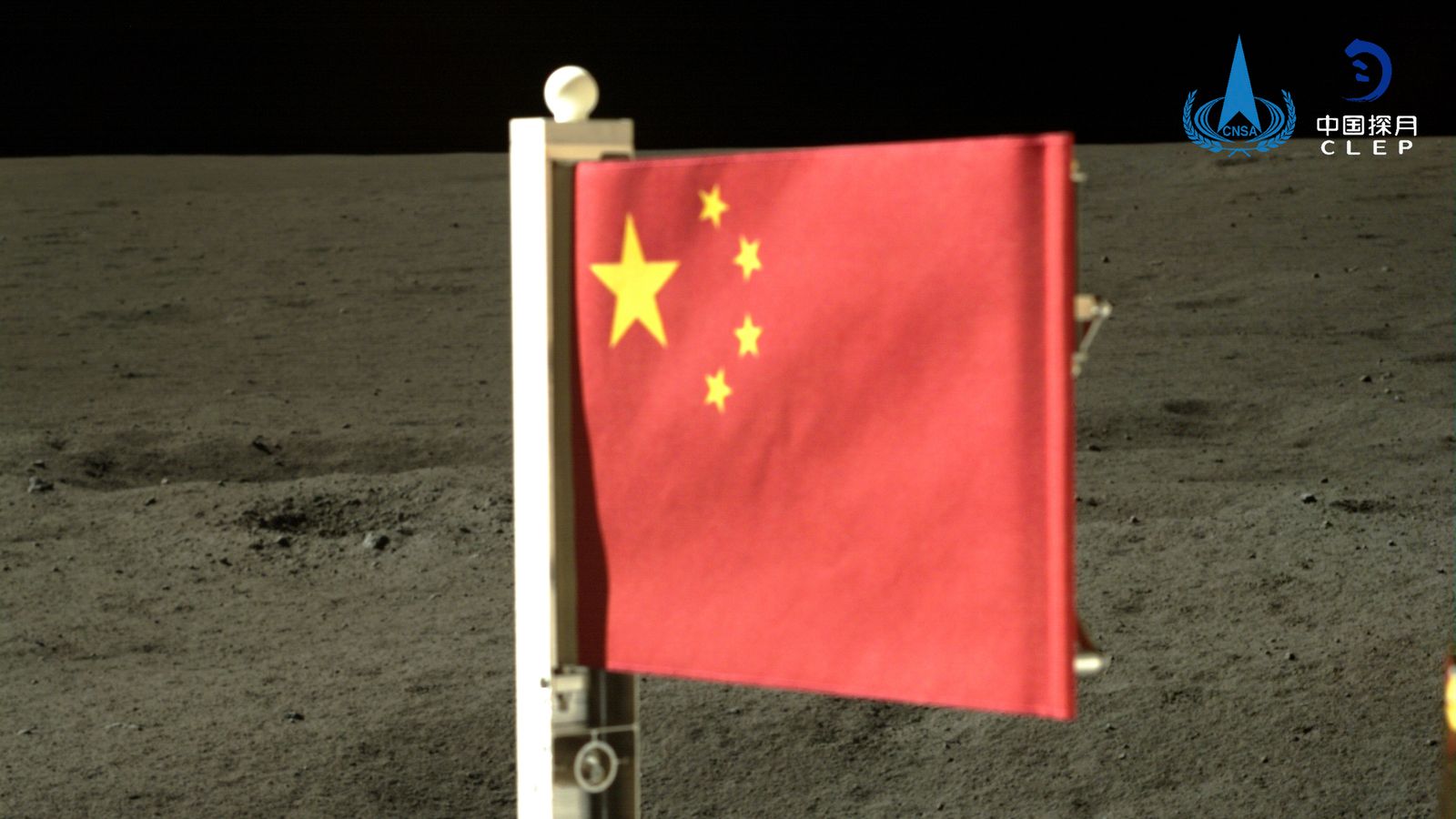
Equipped with a robotic arm and a drill, Chang’e-6 managed to acquire subsurface rocks and soil samples before proudly displaying the Chinese flag on the lunar terrain.
“Mission accomplished!” declared Foreign Ministry spokesperson Hua Chunying on X, formerly known as Twitter, adding, “An unprecedented feat in human lunar exploration history!”
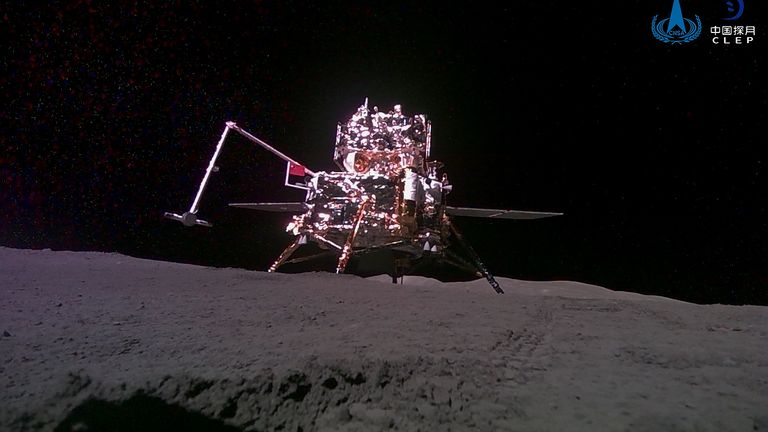
Chang’e-6 lands on the lunar terrain. Credit: China National Space Administration via AP
The Chang’e-6 mission was launched to the moon last month and successfully made its landing on a Sunday, marking its place in history.
The spacecraft’s return capsule is anticipated to land in the desert region of Inner Mongolia, China, on the 25th of June.
Exploratory missions to the far side of the moon are challenging due to the necessity of relay satellites for communication and the rugged, uneven terrain which offers fewer landing opportunities.
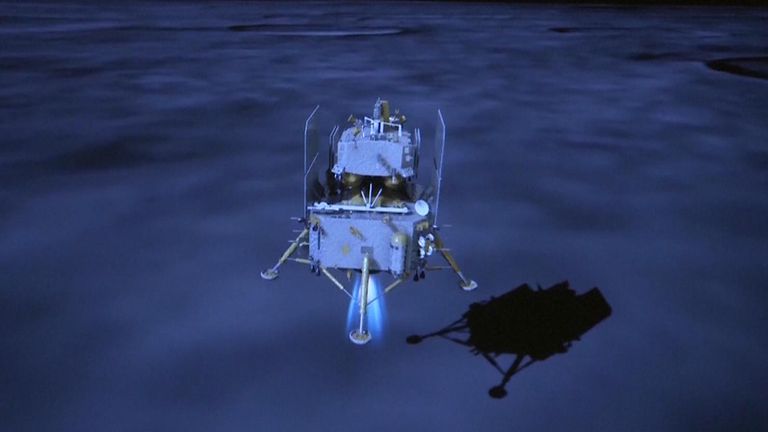
From the recent launch: China’s spacecraft touches down on the moon’s surface
The landing region selected by the Chang’e-6 mission, the South Pole-Aitken Basin, is a significant site composed of an ancient and vast impact crater thought to have formed more than four billion years ago.
This has heightened interest among scientists who believe the basin could yield crucial information regarding its formation and moon’s early history as deep-seated materials could have been uncovered due to the impact that created it.
The Chang’e-6 is the latest in China’s series of lunar missions named after the mythical Chinese moon goddess and is the country’s second successful landing on the lunar far side, following the previous Chang’e-4 mission in 2019.
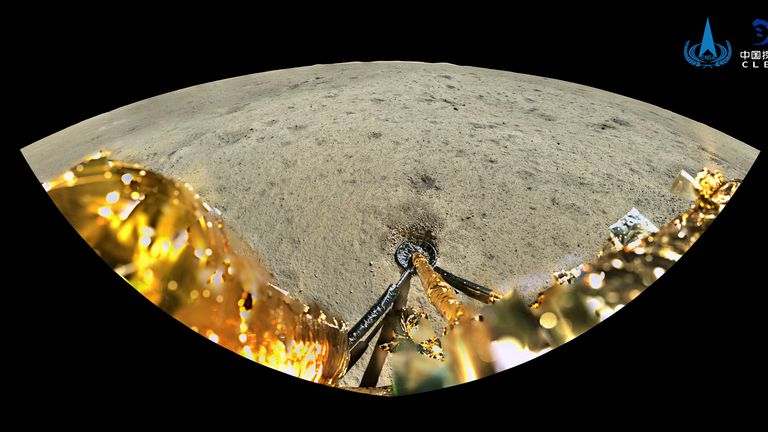
The moon’s landscape as seen by Chang’e-6’s panoramic camera. Credit: Xinhua News Agency /AP
Amidst the escalating space race involving several nations such as China, India, Japan, and the United States, China has set an ambitious goal to send a human to the moon by the year 2030, while the US space agency NASA expects to return with a manned mission in September 2026.
Frequently Asked Questions
- What is the significance of the Chang’e-6 mission?
- The Chang’e-6 mission is significant as it marks the first time a spacecraft has collected samples from the far side of the moon, which could provide insights into the moon’s geological history.
- What were the challenges of the Chang’e-6 mission?
- One of the main challenges was maintaining communication with the spacecraft, as the far side of the moon is not visible from Earth, requiring a relay satellite. Additionally, the lunar surface is rugged with fewer flat areas suitable for landing.
- What is the South Pole-Aitken Basin?
- The South Pole-Aitken Basin is an ancient impact crater on the moon, thought to be one of the oldest and largest of its kind. It may contain materials from deep below the moon’s surface, offering valuable scientific data.
- Has China landed on the far side of the moon before?
- Yes, China’s Chang’e-4 mission was the first to achieve a successful landing on the far side of the moon in 2019.
- What are China’s future goals for lunar exploration?
- China has expressed its intention to land a human on the moon by 2030, expanding its role in space exploration and the international space race.